What Happens in Your First Somatic Therapy Session?
You’re probably very curious about what happens in the first session of somatic therapy. I combine a variety of therapeutic approaches, and in the first session, I will generally ask you about your intention for this process. What would you like to gain from it? What would you like to be different in your life? And what are you willing to do to support that change?
It’s important to understand that not everyone is ready to begin therapy using a somatic approach. Most of us are not accustomed to being in contact with our bodies, so this process looks different for every person. During the first session, once you tell me what you would like to work on or heal, I will ask you certain questions about the sensations you notice in your body.

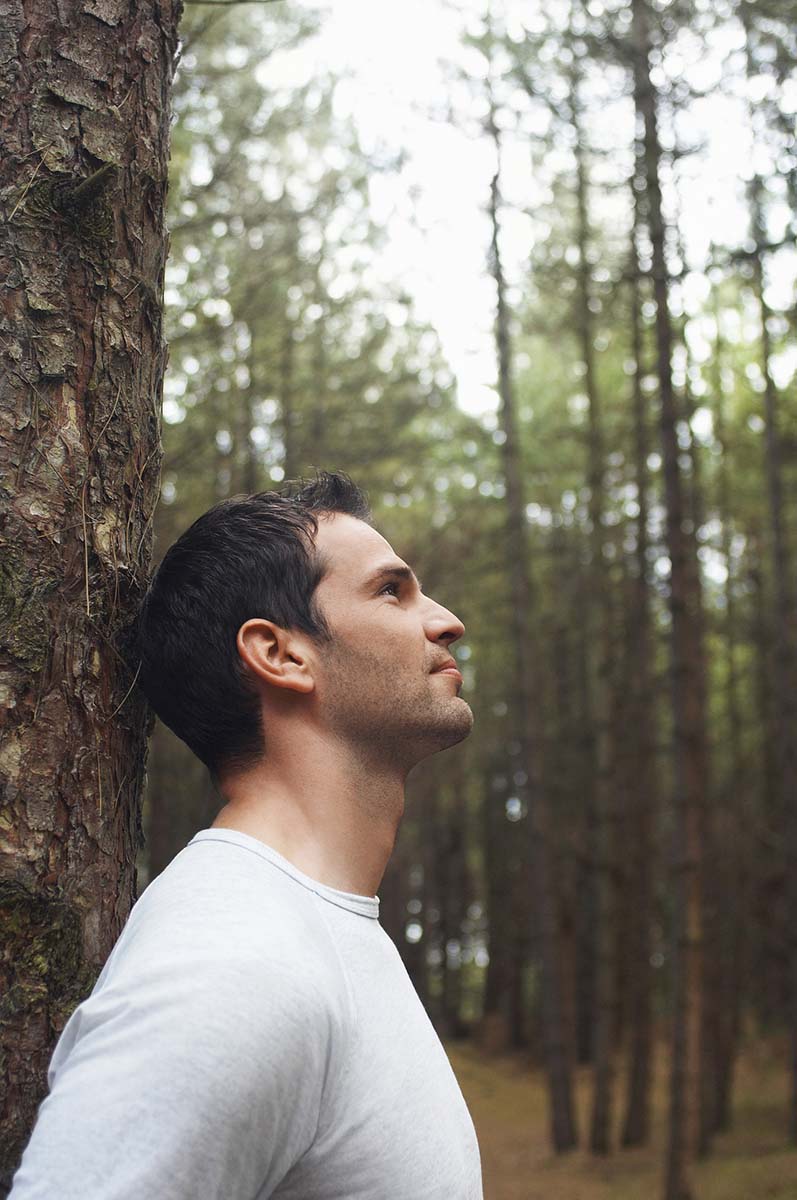
Side view of a man leaning on tree trunk while looking up in forest
The Reality of Body Connection
Some people respond in ways that indicate they are not yet deeply connected to their bodies. It is very common for people to tell me, “I’m very connected to my body. I feel a lot.” Yet when I ask them to identify physical sensations or name emotions as they are experienced in the body, they often find it quite difficult. On the other hand, some people say, “I don’t feel anything,” and yet when we begin exercises focused on noticing sensations and emotions in the body, they find it surprisingly easy.
Generally, the people who find it easier to connect with their bodies have already done some personal or emotional work. They may regularly practice yoga, meditation, breathwork, or other forms of self-awareness. Those who struggle more often have never worked somatically before, have a strong fear of feeling their emotions, or experience significant blocks that make it difficult to connect with their bodies. In these cases, we first work with the blocks that are preventing connection.
Reconnecting to Access Inner Answers
Developing a relationship with the body helps us understand ourselves more deeply. It allows us to access the answers we need and gives the body permission to do what it naturally needs to do in order to release stuck or unresolved energy. However, this process cannot happen until a person develops sufficient contact with their body. For most people, it takes between two and four sessions to feel more connected to their bodies and begin sensing what the body needs to express or do.
As we deepen our connection with the body, memories, insights, and awareness often emerge that help us understand why we behave in certain ways, react to particular situations, or experience specific triggers. We begin to recognize our coping strategies and behavioural patterns. We understand why we may feel disconnected from ourselves, from the present moment, from others, or from our emotions. We also begin to see how we may have become disconnected from our instincts and intuition.
The Impact of Disconnection
When we are disconnected from our bodies, intuition, emotions, sensations, and instincts, we often experience anxiety and depression. We may overthink, seek validation from others, struggle to set boundaries, find it difficult to say no, and carry a deep fear of rejection. We may hesitate to pursue our dreams and feel stuck in life.
A central goal of this approach is self-discovery and developing self-awareness. But even more important is cultivating self-empathy and self-compassion. Many people believe they already have these qualities, yet when we explore them through experiential exercises, they often discover that self-compassion is much more challenging than they expected.
A Safe, Paced, and Holistic Approach
Because many people are afraid of feeling their emotions, we move very slowly. You always remain in control of the process. You have the authority to say when something does not feel right, when something does not resonate, or when you need to set a boundary. You can decline any exercise, and we will always proceed at a pace that feels safe and manageable for you.
It is also important to understand that meaningful healing cannot happen by working only with the body. To achieve lasting results, we must also understand and include what is happening in your mind and emotional world. Nothing exists in isolation. If you are looking for a therapy that focuses solely on the body, this may not be the right fit for you. In this approach, we do not separate the body, mind, emotions, and spirit. Everything is interconnected.
Healing Beyond Physical Symptoms
Even if you come to therapy because of a physical injury or ongoing pain after an accident, we will still explore the limiting beliefs and unconscious stories you hold about yourself. These beliefs can unknowingly interfere with healing and recovery. By raising their awareness, we create the conditions for deeper healing, growth, and transformation.
This approach blends a variety of therapeutic modalities. If you are looking for a therapy that focuses only on the body, where you do not need to explore emotions or observe your thoughts, then this may not be the right fit for you. Even if you are seeking support following an accident or a physical injury, we will still need to explore your emotional experience and thought patterns.
The Role of Early Life and Nervous System Adaptations
More often than not, these emotions and beliefs have roots in early life experiences. From the moment we are born—and even before birth—our nervous systems and brains are shaped by our environment. We develop beliefs about ourselves, many of which are inaccurate or limiting. We also develop coping mechanisms and survival strategies designed to help us maintain attachment with our caregivers and navigate our surroundings.
When a child grows up in an environment that is emotionally safe, nurturing, attuned, and supportive, they are more likely to develop resilience. However, when a child does not receive the protection, attunement, and emotional support they need, they often carry unresolved adaptations into adulthood.
Understanding Trauma Responses
As a result, when a person later experiences a single traumatic event—such as an accident, assault, natural disaster, or other overwhelming experience—many of these earlier adaptations can be activated. Old fears, survival strategies, coping mechanisms, and deeply held beliefs about oneself often rise to the surface. This is one reason why two people can experience the same traumatic event and have very different outcomes. Not everyone who goes to war develops Post-Traumatic Stress Disorder (PTSD).
Research and clinical experience suggest that a person’s early relational environment, attachment experiences, and developmental history can significantly influence how they respond to later trauma. When a child grows up without consistent emotional attunement, safety, or support, they may become more vulnerable to developing symptoms of PTSD following a traumatic event later in life.
For this reason, when we work with the effects of a single traumatic event, it is often necessary to explore aspects of the past. This is not because we are looking for something to blame, but because earlier experiences may be shaping how the nervous system responds in the present. By understanding and working with these deeper layers, we create the possibility for more profound, lasting, and sustainable healing.